Image Map

Sunday, October 23, 2011

Bookworm

Today I made a risky choice. I went into Barnes and Noble. Might not be a risky choice for most people, but as elementary teachers we know that the children's section can be a very dangerous place! I had some time to kill before meeting a friend so I let myself have some book browsing time.

It never amazes me how MUCH I love reading new children's books. I had an awesome Children's Lit professor (hey Beth Frye) who really made me love children's books more than I already did. She always challenged us as teachers to expose our students to high quality books and be readers ourselves! I find myself giggling when I read brand new children's books at a bookstore.

I found a few titles that I had to share. I only let myself buy the following 2:
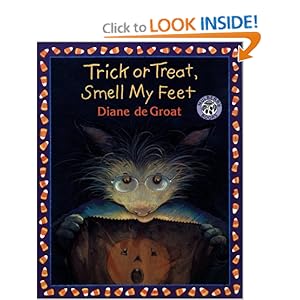
Trick or Treat, Smell My Feet by Diane DeGroat - I love Diane's books. Gilbert is such a lovable character that I think all children can relate to. He always learns a valuable lesson in each book. I didn't have this one yet, so I decided to add it to the collection.
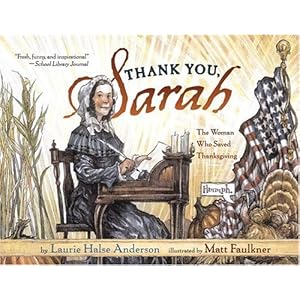
Thank You, Sarah by Laurie Halse Anderson - This is a completely new one to me. The book tells how one woman helped make Thanksgiving a National Holiday after years of trying. There is so much history weaved into this book it would even be great for much older children (and adults) to read as well.

This last book I did not buy but I REALLY want.
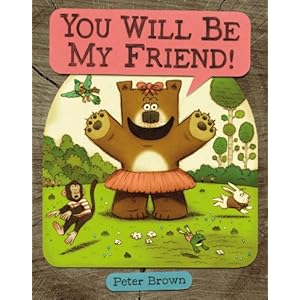
Lucy the lovable and very excited bear is back in another fun story by Peter Brown. I originally wrote about one of his books Children Make Terrible Pets in this post. You Will Be My Friend was just as much fun! The illustrations are vivid and fun and Lucy is hilarious! I'm hoping the school library gets this one so that I can read it to my kiddos!

Friday, October 21, 2011

Math Games!

This year I have started doing math games 3 times a week while I work with small groups. I have been wanting to start something like this for a while but couldn't seem to figure out how to make it work. I can't do math rotations for my entire time but my math time backs up to my team time/intervention time so I have my kiddos do math games while I work with a group of students.

I needed a good way to organize all of the materials. I used extra book baskets and made labels for them. I store the bins on a rolling cart that can be taken apart. I've had it for college and used it for storing things at school and home. The great part is that it rolls! I can't really have things in permanent places since I have to pack up my classroom every 9 weeks.


When it's time for math rotations I simply roll the cart to the carpet so that the kids can simply grab the basket they need.


Game #1 - Pumpkin Poke Addition - A great FREE Teachers Pay Teachers find. The kids "poke" the correct pumpkin using a pencil and check the answer on the back. The correct answer has a green circle around the punched hole.


Game #2 - Power Towers - From Teacher Tipster. This is such a popular choice right now. After someone chooses Power Towers there is a big sigh of disappointment from everyone else. I need to make a subtraction one soon! I have my kiddos do this one on the carpet so it's quiet.


Game #3 - Hundreds Board - I found this cute activity from Christina Bainbridge. I have the kids roll a die onto the hundreds board and then write the number the die lands on in the middle square and then figure out what 10 less, 10 more, 1 less, and 1 more are and write them in.


Game #4 - Race to 100 - Great for practicing regrouping 10 ones for a 10 stick. I found this cute safari one on TPT from Primary Graffiti.

When I first introduced math game time to the kids I MODELED each and every game in front of them. Some of them they had played before, others were new. I chose students to model for the class how to play the games, clean them up, and put the bins back on the cart.

We also had a big talk about using a "whisper voice" during math game time just like during Read to Someone in Daily 5. I limit the number of students I allow to Read to Someone to 6 during Daily 5 but during math games every child is working with a partner so the volume can quickly increase. The first day we did math games it was NOT quiet. I was very frustrated as I tried to work with my small group.

The following day we reviewed using a whisper voice again and practiced touching our hands to our throats to feel vibrations. If you can't feel the vibrations of your vocal chords when you speak then you are whispering. My Aunt (a 5th grade teacher) taught me this one and I love it! They did SO much better that day. I also told them that my assistant would be looking for the quietest pair to give them 10 eagle bucks. I am so not above bribery.

Stay tuned to see the rest of my math games!

Thursday, October 20, 2011

Community Project

We just wrapped up our Social Studies unit on Communities. We focused mainly on how communities today are different from the past. It's one of my favorite social studies units. The kids love learning about how people lived in the past. We also learn about the types of communities today. Our 3 main buzzwords are rural, urban, and suburban.

After reading in our textbooks about these communities and reading some non-fiction texts the students began a project to make their own community examples. I assigned each team a type of community. First they had to brainstorm what their community would include. They were very creative. I heard all sorts of ideas from a farmer's market in a rural community to Dunkin Donuts in the suburbs, though that one may be because their teacher has a thing for iced decaf mochas ;).

After I approved their plans - I was the Community Manager (like a City Planner) I set the groups loose to make their community models. Each group got a large piece of butcher block paper and a variety of construction paper.

It took us 3 days to actually make the models. During Social Studies it looked like construction paper exploded in the classroom - it was a MESS!! I told myself to let my neat tendencies go for just a little bit and let them create! Definitely one of those moments when I remember that I was taught that "knowledge is socially constructed" in college.

Here are the finished products. They did such a great job and turned out really well!

Rural
Rural - Complete with a barn, farmer, and farm animals. Very cute!

Suburban - The large yellow part is an arena for sporting events and concerts. They also included a monster truck stadium. :)

Urban - Complete with an airport, city park with a pond, and my personal favorite - Old Navy! :)

Suburban

After the projects were made I had the kids spend one day reflecting on their community. They filled out a community snapshot sheet where each group member wrote 2 sentences about their community and drew their favorite part. The following day they presented them to the class.


Teaching Text Features

As we dive into 2nd quarter my reading instruction is now full of non-fiction. Most of our reading objectives for the quarter deal with non-fiction. While my second graders usually know what non-fiction is and how it is different from fiction, they often don't understand most of the conventions, text features, and how to retell. So we spend a LOT of time in our minilessons learning all we can about non-fiction.

I've started out by introducing text features. I had an old poster that had a list of non-fiction text features on them in marker lettering. It wasn't fancy but it worked for the time being. As I started out this year's unit I couldn't seem to find that poster. I searched high and low in my carts but couldn't find it. So this morning during arrival I decided to make another one. Somehow this is what I ended up with:
I think it turned out pretty good! It's much more colorful and interactive than the old one and I included actual examples of some of the features from magazines. I enjoyed adding the colors and making it fun. I see anchor charts all over blogs and Pinterest that are so fun and to be honest I usually don't have the time or skill to make mine look that good. But this may be a stepping stone to livening up my anchor charts!

I made sure to include "why" author's use text features. Some older grades teachers have told us that their students may be able to identify text features but do not know why they are put in a book or text.

Of course, there's a major emphasis on USING text features to help students understand what they are reading. It's a strategy after all!

While I'm on the subject of non-fiction I have to give a shout out to Beth Newingham and her post on teaching non-fiction. I love her text feature books that the kids make with magazines. I made them with last year's class and will be pulling them out again soon! I also printed all of the posters to post near our carpet area.


Monday, September 26, 2011

We LOVE Howard B. Wigglebottom!

Last year I discovered the blog Books That Heal Kids and immediately became hooked. It's such a fabulous website with reviews of tons of books that teach kids about character traits, self confidence, making friends and life in general.

One series of books that I discovered through the site was the Howard B. Wigglebottom books. Howard is a lovable bunny who has books in which he encounters all sorts of problems and life lessons. The great thing is you can see/hear all of his books read aloud online at the author, Howard Binkow's, website We Do Listen. I showed last year's group the book about bullying and they loved it. It has a REALLY fun song/rap all about bullying and standing up for yourself or others. We started singing the song during Morning Meeting as well.

Howard Learns to Listen is perfect for the beginning of the year when we talk about what it looks like and sounds like when you are a good listener. The best part is Howard is so silly and fun and the kids love him! I usually let them go to the website to hear the stories for a week or two for listen to reading and it's always a hit. Sometimes I'll catch them singing along to the songs with their headphones on. So cute. :)

There are also awesome games and coloring pages on the website as well. My kids last year really loved art and coloring so we did a few of these to reinforce what we learned.

After watching all of the stories online at the beginning of this year I decided to buy all of the books to have in the classroom. The great thing is Howard Binkow sells them to teachers for only $6 each for a hardcover. That's an awesome deal!


Have You Filled A Bucket?


As I continue on my journey of teaching, I feel that I learn new things all the time. As a teacher I am always learning new ideas, strategies and ways to do things. Last year I realized that my academic teaching goes so much further if we have a healthy, positive learning environment. I began to look for easy ways to integrate character traits and positivity into our daily routines.

A couple weeks ago, I pulled out book Have You Filled A Bucket Today? to use for a minilesson. The kids love this book and the concept is so simple. It teaches them about kindness in such a simple, easy to understand way. We read the book at least 3 times in a few days, stopping to talk about what it means. My sweet assistant read it to them during snack one day and then had a great talk about how they could fill buckets at home and school. She challenged them for their "extra homework" for the night to see if they could fill someone's bucket at home that night and then come back to school ready to share. The next morning at Morning Meeting we stopped at the end to share how we had filled buckets. It was so sweet to hear the ways they filled buckets at home! People often don't give kids enough credit - they are so creative and really do want to do the right thing!

So I decided to take the bucket filling a little further in the classroom. I printed out some bucket filling slips and then wrote the name of each student in my class on one slip. After we read the book again for the bazillionth time I told the kids that they were going to get a chance to fill someone's bucket right then. I had them put up their no peekers (file folder office/study buddy) so that it would be a super secret. I gave each student a slip with someone else's name and told them to write a nice thing to that friend. I then collected them and checked them all to make sure they were sweet and kind before passing them out. We sat on the carpet in a circle and when I called each student's name they came up and read it to themselves and then to the class if they wanted. They were beaming as they read what someone else wrote about them! It was too sweet!

The following week one of our awesome guidance counselors came to do her first lesson for the year with the class. Lo and behold her lesson was on bucket filling! She said we were the first class that had already read the book. She reviewed it again with the kids and they had fun sharing the ways that they had already filled buckets. I am now thinking that we will add filling buckets to our Friday Awards Ceremony. Our guidance counselor made us a cute bucket with blank slips to keep in our classroom.

I would like to have a bucket filling area in the classroom but with moving every 9 weeks it needs to be something simple. I have seen all sorts of cute bucket filling displays using buckets and pockets around the web. Any ideas for a portable one?

Resources:
- Bucket Filling Ideas on What the Teacher Wants

Wednesday, August 31, 2011

Retell the Story with Post-Its

A while ago I found a cool story map on Pinterest that uses Post-Its. I used the idea to make my own large story map to use with post-its for whole group mini-lessons. It is perfect for practicing retelling the story.
After we read a story as a whole class, the students retell parts of the story and I record their answers on the stickies. I usually keep up those stickies for the rest of the day or longer.
Note: I often don't record connections on stickies when we do it as a whole group as this could take forever. I let as many people as I can share their connections verbally making sure to say if it is a Text to Self or Text to Text connection first.

We have talked about how what you write doesn't need to be in complete sentences and how it doesn't have to be fancy, but you should be able to expand on your thoughts when you talk about the story.

After modeling and practicing using the story map many times during mini-lessons I gave the kids their own story map to use during Read to Self or Read to Someone. I also use the student sized version during my Retell the Story strategy group. The kids keep their story map in a clear sheet protector in their Daily 5 folders. I also gave each student their own pad of Post-Its!!! It was like Christmas, hehe. We did have a nice chat about using Post-Its for reading and to become better readers, not to pass notes to a friend. As I have walked around the room lately during Daily 5 I've noticed many of them with their folders out using their stickies to retell the story. Yes!!